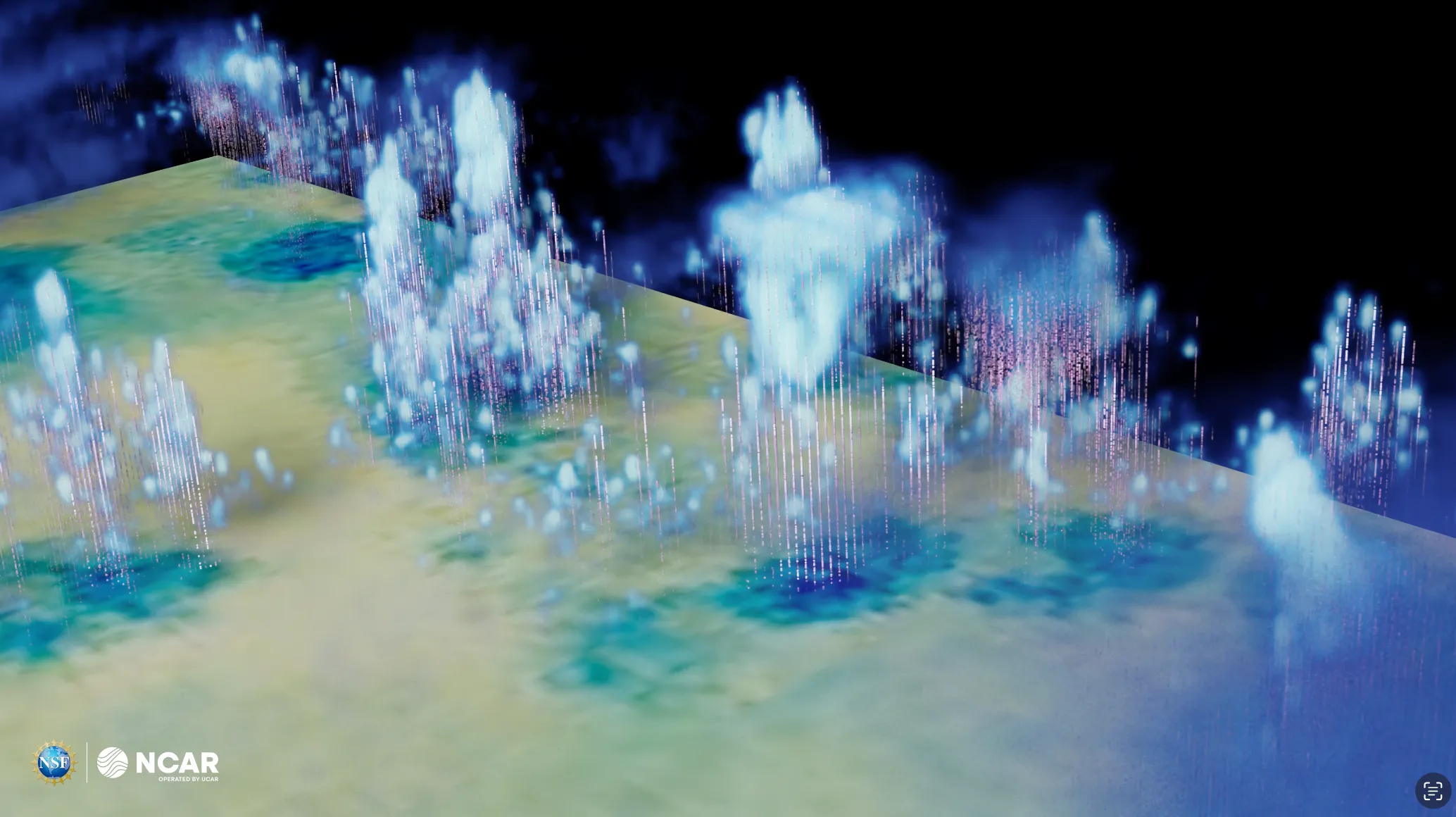
This animation features Lagrangian particle tracking in a simulated deep convection over ocean surface using SAM (System for Atmospheric Modeling). The simulation domain is 128 x 128 km with 500-m horizontal spacing on a doubly periodic domain and stretched vertical grid with spacing ranging from 80 m near the surface to 1 km in the stratosphere. Hundreds of millions of Lagrangian particles are released in the entire domain to track air motion. QN represents non-precipitating water content, and QP represents precipitating snow and rain content.
Volumes: QN - Non-Precipitating Water Content (g/kg)
Particles: QP - Precipitating Snow and Rain Content (g/kg)
Surface: MSE - Moist Static Energy (K)
Funding Acknowledgement: This material is supported by NSF NCAR, which is a major facility sponsored by the National Science Foundation under Cooperative Agreement No. 1852977.
Reference: Tian, Y, Z. Kuang. 2019. Why Does Deep Convection Have Different Sensitivities to Temperature Perturbations in the Lower versus Upper Troposphere? Journal of the Atmospheric Sciences. DOI: 10.1175/JAS-D-18-0023.1
Yang Tian (NCAR/CGD)
Matt Rehme (NCAR/CISL)
Python, Blender

The National Center for Atmospheric Research is sponsored by the National Science Foundation. Any opinions, findings and conclusions or recommendations expressed in this material do not necessarily reflect the views of the National Science Foundation.